Monday, April 28, 2014

Flowers and Fences


A year ago today I left Palestine for the US.  I had been there for three months; the Palestinian landscape had changed from early spring to almost summer and my life had been irrevocably changed.  Today, I am going through the photos that I took in Palestine, trying to prepare an exhibit for my church’s Annual Conference.

Flipping through almost 2,000 images, I was struck by how many photos I had of the Wall.  Pictures of the checkpoints, of agricultural gates and school gates, of graffiti and barbed wire.  The next impression that hit me was how many photos I had taken of flowers!  Someone told me that the poppy was a symbol of hope.  That must have penetrated at some level, because there were lots of poppy photos!  There were also photos of blossoming trees, of Queen Anne’s lace, of wild daisies and many other beautiful wildflowers whose names I never did learn!

But more than an opportunity to weep over an Occupation that has only worsened in the year I’ve been gone, and more than the chance to view the beautiful flowers of hope, my “trip down Memory Lane” also afforded me time to reflect about where I am. 

Advocacy?  Sure!  That was a big piece of the EAPPI experience – on the ground learning, followed by active advocacy.  I’m still at it – giving presentations at churches, community organizations and anywhere else I can wrangle an invitation.  Also taking advantage of opportunities to make impromptu “soap box” talks at places as diverse as the bridge table, and “cocktail hour” in the lounge of my new residence! 

A lot of my time and energy are taken up by the Holy Land Task Force that was formed by my (Methodist) church’s Annual Conference last year – with its goal to educate congregations and clergy about the reality of life in Jesus’ birthplace, (and my ultimate goal  of  advocating for divestment through the international church community!).  I played a minor part in organizing a local Sabeel Conference as well, and am working on a book about my experiences in Palestine.
   
But I’ve also been reflecting on how my experiences in Palestine changed me as a person.  After all, I always was kind of opinionated - and outspoken in my convictions as to what I believe is right and wrong!  And that hasn’t changed!! 

What has changed, I think, is that my passion has been mellowed with patience.  I’ve seen the patience of the Palestinian people, as they live lives narrowed by forces out of their control, yet lives that are happy, peaceful and fulfilling.  I’ve spent hours taking journeys that, under other circumstances, would have taken far less time!  I’ve wakened to the sound of the adhan and laid in bed, thankful to be in such a place where the world stops for prayer five times every day.

My world isn’t stopping; it continues to spin.  And I continue to pray and work for an end to a brutal Occupation – and for the American people to wake up and stop enabling this Occupation!  Still, there are many images that take me back to a busier – yet more peaceful – life in Palestine and I know I will return.

Saturday, April 12, 2014

Easter In Jerusalem


Courtyard of Church of the Holy Sepulcher

With the approach of Easter next week, my thoughts have turned to last Easter – an Easter that I spent in the Holy City of Jerusalem, participating in an Easter sunrise service on the Mount of Olives – on the grounds of Augusta Victoria Hospital.  I was an EA last year – living and working in Tulkarm – and my Easter sojourn was one of my three two-day “vacations” from the job (the other two were in Tel Aviv and Jericho).

I spent Maundy Thursday in Bethlehem, on a placement visit with EAs there, and crossed over to Jerusalem (through the infamous “Checkpoint 300”) on Good Friday morning.  I crossed late enough to avoid the crowds of Palestinian workers, but was in the queue with Palestinian Christians who wanted to spend the holy day in the holy city.  Alas, for most it was not to be – the Israeli soldiers turned away these “pilgrims,” despite their valid permits, with impunity.  Likewise, most Muslims who wished to pray at the Al Aqsa Mosque were turned away; only a few very elderly men and women were allowed to pass.
"Typical" checkpoint crossing

Once in Jerusalem, I noted the heavy presence of soldiers at all gates to the Old City.  Here, too, pilgrims were denied access to Via Dolorosa and the Church of the Holy Sepulcher.  I ran into a few internationals that I knew – a Canadian minister, an American missionary.  They had just walked the Via Dolorosa and reported that local people were not allowed to enter the city; only members of the international community had the “golden ticket” to enter!

I proceeded up the hill to the Augusta Victoria guesthouse, where I was spending the weekend, and didn’t even try to enter the Old City until Sunday morning, after the sunrise service and before catching my return bus to Tulkarm.  The service was beautiful and the brunch at the home of the hospital’s chief administrator, was very pleasant, but I couldn’t get the local Christians out of my mind.
Sunrise service on Mount of Olives - Easter 2013

Why were we “foreigners” allowed the privilege of entering a place that was closed to the indigenous Christians who have been worshipping there since the time of Christ?  And when and how will this madness all end?

I believe most who are following the most recent “peace talks” have concluded, as John Kerry allegedly did a few days ago, that these talks, like all of their predecessors, will go nowhere and solve nothing.  I also believe in the power of the people (both abroad and in Palestine/Israel) will provide the ultimate “solution” to this intractable situation.  And I firmly believe that BDS is the best option available to obtain a “just” solution (I will expand further on this at another time!) 

In the meantime, I understand that matters are even worse in Jerusalem this Easter season than last.  Fewer permits have been issued to Palestinian Christians (and those that have been issued have frequently gone to young children, but not their parents!); more soldiers will be manning the gates to the Old City; again, the local Christians – the “stones” who can trace their ancestry to the direct followers of Jesus – are being forced out.  Further, more children are being detained; more olive trees destroyed; more people are being killed and the lines at the checkpoints are even longer.  When, indeed, will they ever learn?


https://www.youtube.com/watch?v=1QZq-wKaBWc&list=RD1QZq-wKaBWc#t=19


Wednesday, February 5, 2014

Walls for Everyone


I am leaving tomorrow morning for a two-week Volunteer in Mission trip to Cambodia.  I was asked to prepare a "sermon" for a service this coming Sunday (hopefully, a translator will be present!)  Below is that sermon:
Section of Wall near Tulkarm, Palestine
I’d like to tell you about a long journey that I made recently – almost exactly a year ago, actually.  I spent three months in the Holy Land – Palestine and Israel – last spring.  As you know, the Holy Land is now a very troubled place, and many people believe it is a violent place, where the Arabs (who are both Christian and Muslim) and the Jewish Israelis want to hurt each other.

I was there with the World Council of Churches, working with a program called Ecumenical Accompaniment Programme in Palestine and Israel, and our job was to work with people on both sides of the Wall to help them live in peace.

How many of you are aware that there is an actual wall between Palestine and Israel?  I’m going to pass around a picture of what a small section of that wall looks like.  Those of us who were working with the church there – and a lot of other people – do not like the Wall. 

Palestinian workers wait in line to pass through checkpoint
If a Palestinian wants to travel from their side of the wall to the Israeli side, they have to go through checkpoints – and often are not allowed to go through at all.  And Israelis are not allowed to go to the Palestinian side (unless they are settlers who live there).  Their government tells them it is “dangerous” and “forbidden” for them to go into the Palestinian territory.

So the Wall – the actual physical wall – separates people.  But so does the wall of ignorance and prejudice separate people – not just in Israel and Palestine, but throughout the world.   In Galatians 3:28, Jesus said, "There is neither Jew nor Greek, there is neither slave nor free, there is neither male nor female; for you are all one in Christ Jesus."  Yet, in Palestine – and in Israel – this very real wall keeps people from getting to know each other and see that they are more alike than they are different.


I could see that Jesus was right; we are all one under Him; and the other people in my team could see it – because we were able to cross the Wall; we were able to meet and talk with people on both sides of the Wall.  But the people who live there are stuck on whatever side of the Wall that they happen to live in – and they can’t meet each other and see each other as people very much like them!

"Warning" sign at checkpoint into Palestine
Every one of us lives behind a wall.  It isn’t a 20 foot high concrete barrier, such as the one in the Holy Land, but it is a wall built of our experiences, our education, our government and our associations with other people.    There aren’t very many people in Portland, Oregon, who know what Cambodia looks like, or what the people of Cambodia are like.  They probably have never met someone from here, and while they may know something of your history – or at least the recent history that the US was involved in – they cannot know or appreciate your culture, because they haven’t experienced it.

Of course, that is true of us too.  Most of you have probably not been to the United States and your knowledge of “Americans” is limited to those of us who have visited here – or, of course, American media, like television, movies and music.

So to return to the scripture about “turning the other cheek,” I think what Jesus was trying to tell us is that we should look for Him in the eyes of everyone we meet.  “The unknown,” the person who is different, should be regarded with the same love and compassion that we would give to our families and to our close friends.  And I do believe that everyone wants peace; the problem comes when we disagree on what peace is – and how we can best find it!


Friday, January 24, 2014

Goodbye, Tulkarm! :-(


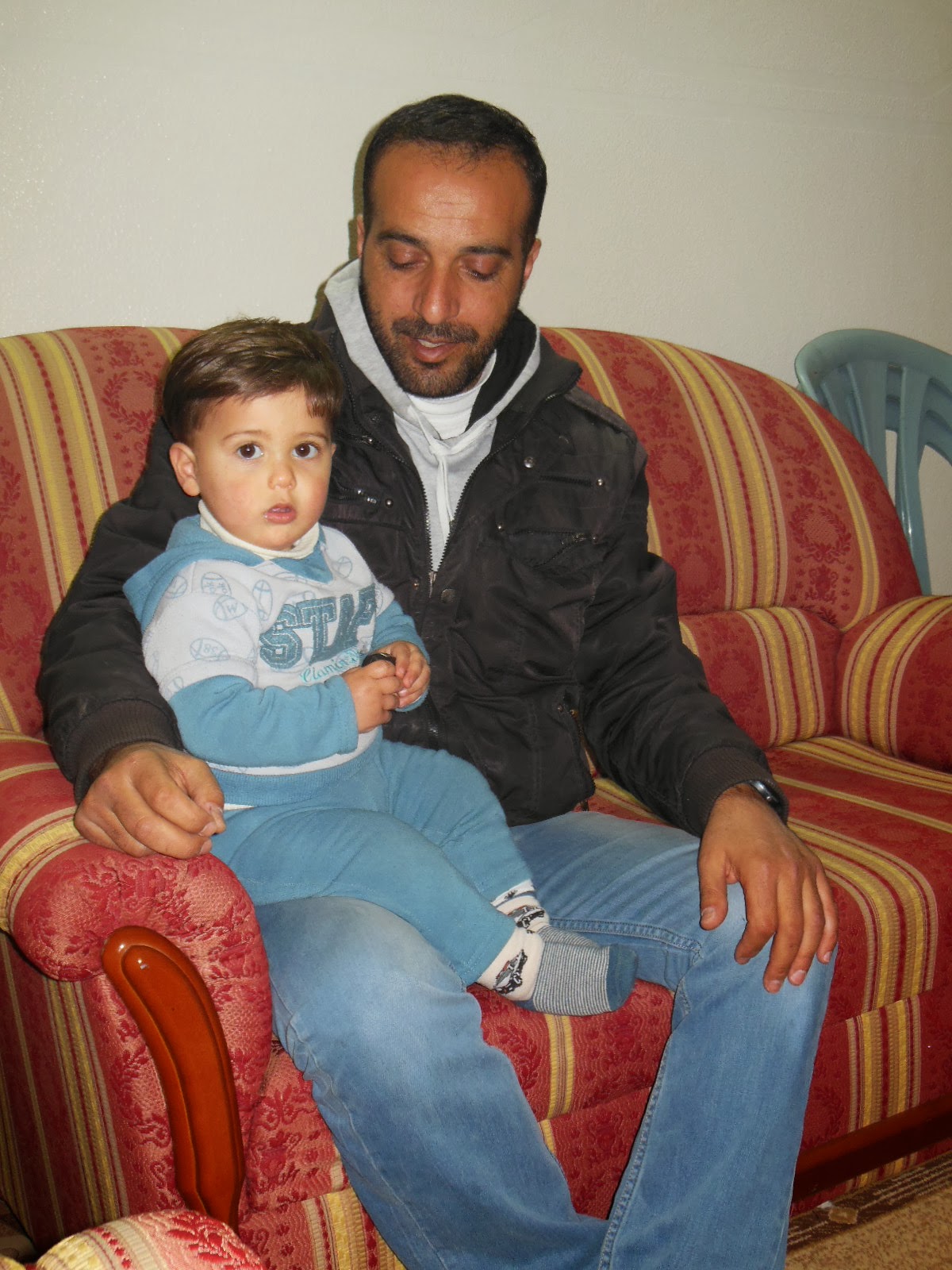
Muawya and son Adam

A few weeks ago, Muawya, our beloved driver-translator in Tulkarm, posted on Facebook that the Tulkarm EA office would be closed when Team 50 (then in residence) left.  I read that post in disbelief – and shed tears.  I was crying not only for the end of an era, and for all the memories I had left in Tulkarm, but for the people I had known and loved there!

I cried for Muawya – who would go back to driving his taxi without knowing that his customers included a group of internationals who cared passionately about the well-being of his family and his nation.  I cried for the women of Shufa, with whom I’drunk tea and eaten fabulous Palestinian cuisine, while they practiced their English and we all laughed together.  I cried for Ahmed, whose village of Sabastiya was but one of many villages plagued by settler violence, yet who always had a ready smile and time to show off the historical beauty of his community.

Agricultural gate through which farmers and shepherds must pass
I cried for the farmers and shepherds, forced to spend countless hours in long lines to cross through agricultural gates so they could tend their crops – and for school children whose education was routinely interrupted by the time they spent going through the  checkpoints between their homes and their schools.  And I cried for the workers, who had to swallow their pride to pass through the inhuman Taybe/Ephraim checkpoint daily – and then to further subjugate themselves to Israeli employers on the “other side,” who treated them almost as badly as the soldiers at the checkpoints. 

The “official” announcement of the Tulkarm closing from the EAPPI office stressed that the placement was NOT being closed, but that the Jayyus team would “now be responsible for Tulkarm priority areas.”  The announcement went on to explain that, “This shift is the result of several years of feedback from EAs and beneficiaries, and discussions with EAPPI’s National Coordinators and Local Reference Group.” 

I understand the office’s position – I really do.  There are only so many people who are willing to take three months out of their lives and live side-by-side with the Palestinians, with the physical and emotional hardships that are part of the “job description.”  And I understand that EAPPI wants to put a team in the Jordan Valley – where anyone who reads even American media knows that serious problems have been brewing for quite a while.

Soldiers detain a young boy
Still, I wonder.  When I was there – less than a year ago – both the Jayyus team and the Tulkarm team (not to mention the other five teams!) were pretty busy – and I understand that things have “heated up” in the time since.  More settler violence, more destruction of homes and crops, more soldier harassment – including of children – more human rights violations to observe and report on, more “accompanying” needed all around!

Sometimes there are no answers.  Sometimes, I just put words on paper to more clearly express the questions – and my feelings about them!  I understand that Team 50, the last team to serve Tulkarm (on a full-time basis, anyway), has had their farewell party – and that Team 51 will be heading in different directions.  And, although my “farewell party” was last April, I haven’t yet truly said “goodbye” to Tulkarm. 


Sunset over the Tulkarm mosque near where I lived

It will remain in my heart – and in my soul.  And when next I return to Palestine, I will go back and visit the friends I made there – and the places that I loved!  Pray for them – and for all the Palestinians who continue to suffer!!